
Ask a group of Year 9 students what their skills are and you’ll often be met with a room full of “I dunno” expressions.
Yet those same young people are solving problems, organising things, supporting friends, learning new techniques and adapting when something doesn’t go to plan.
They have skills. They haven’t necessarily recognised them or found the words to explain them yet.
If we want young people to understand their potential, we need to help them see evidence of what they can already do.
A promise I used to make
Back in my Next Steps Cornwall days, I would promise every student in our skills sessions that, by the end, they would know they had skills. They would also know which ones needed a bit of practice.
We used small, achievable tasks to help students notice their contribution, recognise an achievement and put a name to the skills they were using.
Something they took for granted could become something they felt proud of. A skill they hadn’t considered could become something they wanted to develop.
You could see the shift as young people began to recognise themselves differently. That was the beauty of those sessions: giving them a chance to discover something about themselves through doing.
The confidence–competence loop
I think of this as a confidence–competence loop.
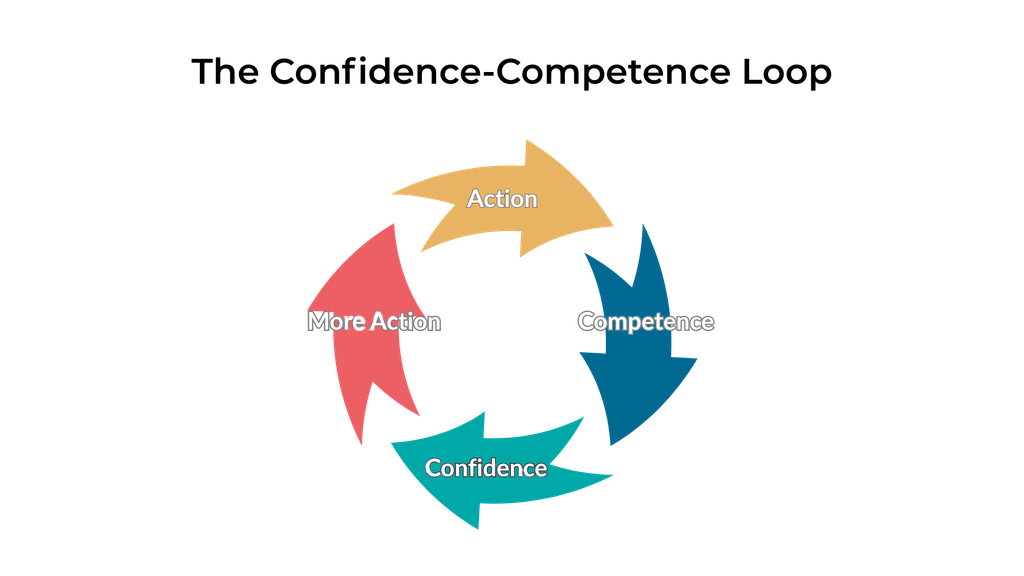
You try something. You recognise what you achieved and how you achieved it. That gives you evidence that you can do it. With greater confidence, you may be more willing to try again, practise or take on a slightly harder challenge.
With the right tools and support, that practice helps you become more capable, giving you further evidence to build on.
The reflection matters. Completing a task doesn’t always mean a young person recognises the skills they used. They might think they simply helped their group finish an activity, without noticing that they listened, explained an idea or worked through a disagreement.
Questions such as “What did you contribute?”, “How did you work that out?” and “What would you try differently next time?” help them make those connections.
They go from ‘I dunno’ to ‘I can’: recognising the skills they already have.”
The psychology behind it
Psychologist Albert Bandura described self-efficacy as our belief in our ability to carry out a particular task. One important source of that belief is a mastery experience: successfully doing something ourselves.
In a skills session, a small achievement can provide a starting point. A young person has something concrete to draw on when thinking, “I could do this again.”
Feedback helps them understand that achievement. “You explained your idea clearly and checked that everyone understood” gives them more useful information than a general “Well done.”
Confidence and competence don’t always rise together. Someone can underestimate their ability or feel confident while still needing practice. The aim is to help young people develop a realistic understanding of their strengths and what they can work on next.
You don’t need a career plan to get started
“What do you want to do when you grow up?” is a big question.
I think it’s just as important to help young people recognise their strengths and understand what they can do as it is to ask what they want to become.
This matters particularly for young people from less well-resourced backgrounds, who may have had fewer opportunities to explore different careers. You don’t need to know your future job to recognise that you’re good at solving problems, organising, communicating or working with others.
These are skills young people can identify, practise and develop now, building confidence and creating a bridge into so many opportunities.
“What did you do well today?” offers an immediate starting point. It gives a young person something they can explore while they continue learning about the possibilities ahead.
Recognising skills developed through everyday life matters too. Caring responsibilities, hobbies, volunteering and helping others can provide valuable examples alongside experiences gained at school.
We need to help young people recognise those experiences and give them further opportunities to develop.
Where the new Employability Skills Framework fits
Skills England’s new Employability Skills Framework provides a shared language for young people, educators and employers. It connects 13 core skills with practical examples of how they develop and what they look like at work.
The framework also maps to existing approaches, including Skills Builder and the Essential Digital Skills Framework, and connects with employability expectations within technical and vocational pathways, including foundation apprenticeships and T Levels.
For me, its value will come through the conversations and activities it supports.
A framework gives us language. Thoughtfully designed experiences give young people something to talk about.
Connecting curriculum learning with real workplace situations can create opportunities to practise, receive feedback and reflect. A young person might leave an activity able to say: “I helped organise our approach, explained my thinking and changed my plan when we found a problem.”
They can describe what they did, recognise the skills involved and identify something to practise next time.
That is what I want young people to take away: a clearer understanding of their potential and a little more confidence to explore where it could take them.
Sometimes, it starts with a small task and someone helping them notice what they did.
Further reading
Bandura, A. (1977). Self-efficacy: Toward a unifying theory of behavioral change. Psychological Review, 84(2), 191–215.
https://doi.org/10.1037/0033-295X.84.2.191
Skills England (2026). Employability Skills Framework.
https://www.gov.uk/government/publications/employability-skills-framework
Leave a Reply